
THE CRITIQUE IS THE POINT: What YG’s “Tiffany” Reveals About Hip-Hop Black Masculinity and the Purpose of Art
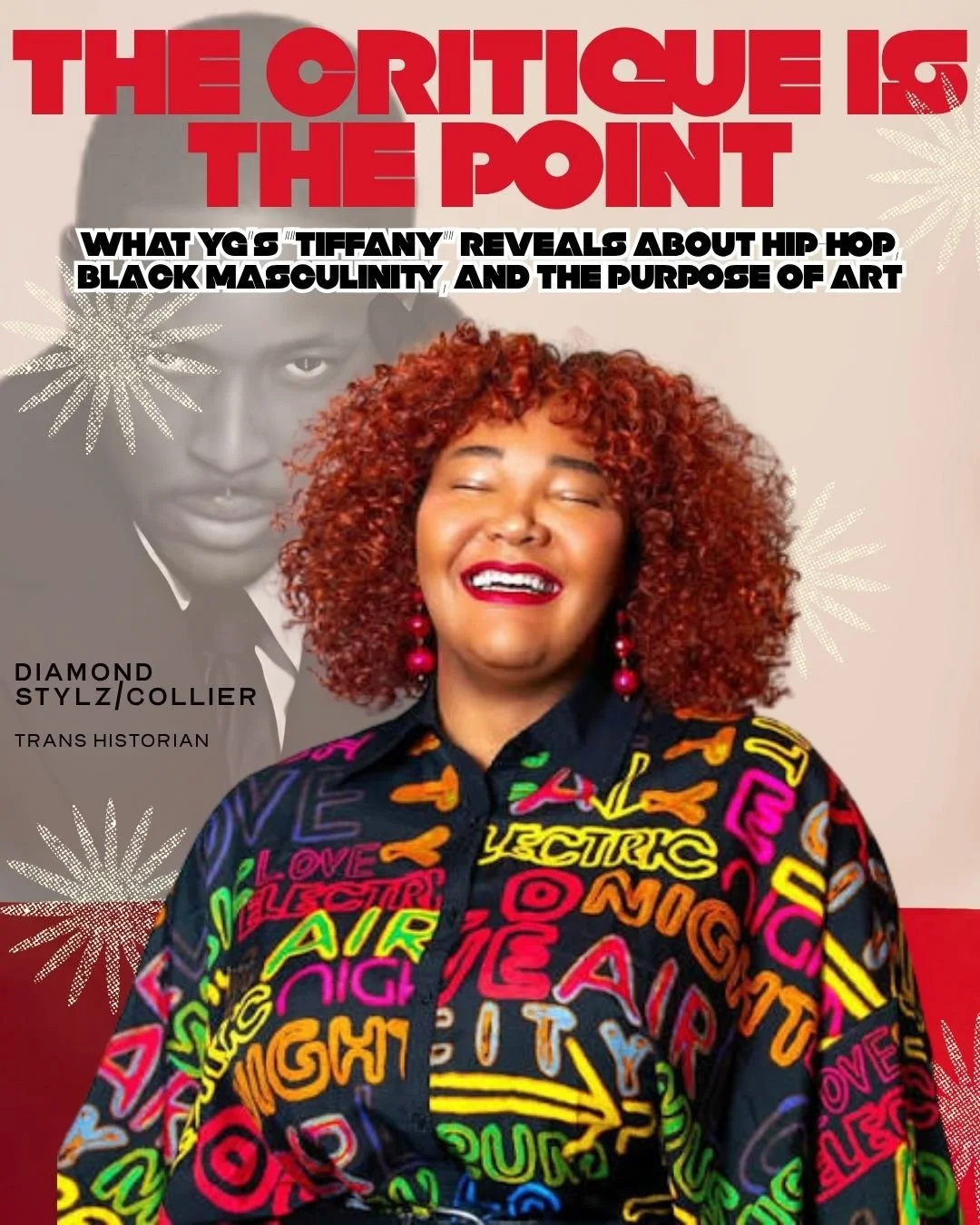
What happens when hip-hop tells Trans stories? When Kendrick Lamar released "Auntie Diaries," the public conversation quickly expanded beyond the music itself. Listeners debated his use of slurs like faggot, his decision to deadname his family members. We ask whether Kendrick’s personal journey to acceptance justified the harm some Transgender listeners felt the song reproduced in its high-stakes time. I was not one of those Trans people. I thought the song was a beautiful, honest reflection of Kendrick’s journey to understanding the Trans experience. I made a full YouTube review breaking it down. In my lifetime, mentions of Transgender people in mainstream hip-hop have been relatively rare. When they did appear, they often went back to those age-old Transphobic tropes, shock value, and anxieties surrounding gender identity. Against that backdrop, hearing Kendrick Lamar thoughtfully examine his relationship to Transgender people on "Auntie Diaries" felt genuinely refreshing. Rather than positioning himself as someone with all the answers, he made himself part of the story, exposing his own ignorance, inherited prejudices, and capacity for growth. We don’t have to agree with all the artistic choices he made, but I respected his willingness to place himself under scrutiny instead of simply scrutinizing Transgender people. That was something I believed deserved serious consideration—not blind praise or immediate dismissal, but deep thought and rigorous critique. That's exactly what I want us all to do.
Now, years later, YG's "Tiffany" has triggered a similarly vigorous debate. Critics have questioned whether the story YG is telling unintentionally reinforces the dangerous "Trans panic" myth by centering a man's violent reaction to discovering that a woman is Transgender. Typical. Although these songs differ dramatically in execution, they share a common ambition: both are attempts by cisgender Black men to use hip-hop storytelling to grapple with Transgender lives, masculinity, and the limits of empathy.
The comparison between these records has often been framed as a question of representation—one song seen as thoughtful, the other as harmful. In my live show, someone even compared it to The Birth of a Nation. An interesting reach, but I think they were comparing it to a propaganda level. This framing overlooks what may be the more significant cultural phenomenon. The value of these rappers' musical contribution to the national discourse lies less in whether they reach perfect moral conclusions. The real value is in the conversations they spark after the last bar ends. Are we not talking about Trans violence? Is that not a conversation we need to have with Black men? The song’s greatest potential lies not in consensus between all of us, but in the confrontation we all should have. We should be addressing this bullshit deception trope because then we can tell the truth about how shame leads to this kind of violence. The art doesn't end when it is released into the world; it begins the natural dialogical dance between creator and audience. This is the place where the power of cultural change lies, in which criticism is not evidence of failure but the fulfillment of the artwork itself.
There is an invaluable symbiosis between artists and the people who experience their work. Too often we imagine artistic creation as a one-way process in which meaning originates solely with the creator, leaving audiences only to interpret or approve. In reality, meaning is negotiated collectively. Listeners bring their own histories, identities, and political commitments to every piece of art they encounter. The work becomes a meeting place where intention and experience collide. It has become a dialogical exchange between the artist and the recipient.
For that reason, the primary value of art is not that it functions as a flawless moral statement. Few enduring works ever have. Remember how the violence of Mister in The Color Purple film was received by Black men in the 80s? Now it's considered classic Black cinema. Instead, art functions as both an image and a lightning rod. It reflects the assumptions, fears, aspirations, and contradictions of the culture that produced it while simultaneously attracting the tensions that culture has not yet resolved. Great works of art often expose society's fractures more effectively than they repair them.
Hip-hop has always been a place where people wrestle with difficult truths. The genre has never shied away from talking about poverty, police violence, racism, misogyny, faith, sex, or what it means to be Black in America. Trans existence has been thrown into the national discourse, and the rappers are up to bat. Are we expecting them all to hit a home run? Hip hop doesn't usually hand us neat solutions. Instead, it gives us a space to work through those questions together.
That's why I think "Auntie Diaries" and "Tiffany" are about more than just Transgender people. They're also snapshots of Black masculinity trying to make sense of something it hasn't always known how to talk about. Looking at the songs this way moves the conversation beyond asking which one is a "good" representation and which one is "bad." What's more interesting is that each song invites us into a completely different emotional experience, and those different experiences reveal something about the people telling the stories as much as the people they're telling them about.
"Auntie Diaries" unfolds as a confession. Kendrick Lamar structures the song around his own evolution, deliberately recalling moments of ignorance, misgendering, and homophobia before examining how those attitudes shaped his understanding of gender and family. He implicates himself in the culture he critiques. Instead of presenting enlightenment as innate, he portrays it as something painfully learned. The audience is invited to recognize its own inherited prejudices within his story and, ideally, to develop alongside him.
Coming at the subject from that lens produced one of the most polarizing responses in my recent memory of hip-hop. I found it to be refreshing. Many praised Kendrick's willingness to expose his own flaws and confront the influence of both the Black church and hip-hop's long history of anti-LGBTQ rhetoric. Some contended that repeatedly invoking slurs like f——t and deadnames reproduced precisely the harms the song claimed to reject. The disagreement itself grew inseparable from the work. Whether listeners viewed the song as courageous or deeply flawed, few remained indifferent.
YG's "Tiffany" occupies a distinctly different narrative position. Rather than contemplating his own transformation like Kendrick, YG constructs a fictional story centered on a man named Chris who discovers that a woman named Tiffany, whom he has taken home, is Transgender and reacts with anger and violence. Instead of welcoming listeners into a process of self-examination, the song immerses them within the emotional logic of wounded masculinity. The listener experiences the fear, humiliation, and rage of a man confronting a challenge to his understanding of gender and heterosexual identity.
The controversy surrounding "Tiffany" has therefore focused less on intention than on narrative framing. Critics have argued that the song reproduces one of the oldest and most dangerous cultural myths surrounding Transgender women: the idea that they deceive men and thereby provoke violence. For a long time, stories like this have focused almost entirely on how the cisgender man feels. His shock, his confusion, his embarrassment—even his anger—becomes the center of the story. Meanwhile, the Transgender woman, who is often the person facing the greatest risk, fades into the background. Too often, we've treated a man's discomfort as the real tragedy while barely acknowledging the fear, violence, and vulnerability that Trans women are actually living with. Do you actually believe that Chris is justified in killing Tiffany, as opposed to just cussing her out and leaving? What we know from the data is that, in my own award-winning investigative research, most Trans women are being harmed or killed by people who know they are Trans. Their deaths mirror the same people we see as the culprits in cisgender women’s homicides: intimate partners. Because you know it's. Not deception.
The essential idea raised by "Tiffany" is therefore not whether YG personally endorses violence. Fiction has always portrayed immoral characters without endorsing their actions. The more difficult question concerns artistic responsibility. When an artist depicts violence rooted in prejudice, what obligations accompany that depiction? Should the story in the song clearly challenge the beliefs it portrays, or can representation alone risk normalizing harmful assumptions? These questions have no universally satisfying answers, especially to my people(Black folks, Trans folks, and women). The complexity of these questions illustrates exactly why the song deserves serious critical engagement rather than simple dismissal as “bad”. Despite their differences, both records occupy an important place within hip-hop history because they attempt something that mainstream rap has rarely attempted at all. For decades, Transgender people appeared in rap lyrics primarily as punchlines, secrets, cautionary tales, or symbols of deception. They seldom emerged as fully realized human beings occupying the emotional center of a narrative. One example is Eazy-E's 1988 song "Nobody Move." In the lyrics, he recounts a fictional robbery and sexual encounter in which the narrator discovers that the woman is Transgender and reacts with shock and hostility. His lyrics were “What I thought was a bitch was nothing but a man.” Another example is Jay-Z's 2001 song "Girls, Girls, Girls." While listing different women from around the world, he briefly references a Trans woman using the dated slur, "tranny": "I got this Transvestite thing from Peru." Eminem also frequently used references to Transgender people for celebrity shock humor throughout much of his earlier catalog. In his 2009 song "We Made You," he jokes about Kim Kardashian and even uses gender-affirming surgery as part of the video's humor, a theme that appears in several of his earlier songs and videos. Against that backdrop, it's notable that both Kendrick Lamar and YG chose to center entire songs around Transgender characters. Whether people see those songs as compassionate, problematic, or somewhere in between, they represent a noticeable change in how hip-hop has engaged with Transgender people.
Now follow me on a lil relevant side quest. Let’s take a look at another piece of art with not-so-perfect Trans representation: Queen & Slim. Uncle Earl is a pimp, and Goddess is one of his hoes being trafficked. Uncle Earl and Goddess's relationship in the movie Queen & Slim illustrates how people living on the margins create their own systems of dignity, belonging, and power when society denies them respect. I think about Goddess's powerful line "Out there, he ain't shit. But in here, he's a king." That Earl is "a king" in their home suggests that, although he has little status in the outside world, he is given significance within his community through love, loyalty, and affirmation. At the same time, the film doesn't present this dynamic as purely positive—it asks viewers to question the emotional labor women often perform to restore men wounded by racism and poverty (remember the famous conversation between late greats Nikki Giovanni and James Baldwin?), and whether creating a sanctuary through hierarchy is ultimately healthy. Lena Waithe brilliantly juxtaposed Earl and Goddess's relationship with the more mutual, vulnerable bond that develops between Queen and Slim, showing different ways Black people seek humanity, chosen family, and self-worth in a world that often refuses to grant them those things. As viewers, we can't dumb this down to just another negative depiction of Trans women as prostitutes, or we can look deeper. Can I rant? I was disappointed that Queen and Slim didn't make it to Cuba. They should have gotten to Cuba and found themselves at the feet of Assata Shakur, looking like a goddess on screen (like Ruby in Is God Is). I think that would've been a more powerful ending. Embedding one of our great yet exiled Black thought leaders in cinema forever and creating a cinematic “fuck you” to the powers that be. I digress gets off soap box I do think of these two characters as great representations for Trans people in the same way that I think these two songs are as well. While not perfect, they are great for us to examine and start a conversation through their imperfections. At the same time, both songs show a significant absence. Although Transgender people occupy the center of both, neither story belongs to a Transgender narrator. Instead, Transgender characters prove to be catalysts through which cisgender men explore their own identities. At the heart of these songs, the emotional core remains rooted in masculine Transformation, masculine fear, and masculine self-understanding. I think they capture something deeply personal about black men today, their fears, their struggles to understand themselves, and the hope of figuring out who they want to be in the world. Do they want to be the stereotypical violent brute, or do they want to be a compassionate person who treats others the way they want to be treated when they're misunderstood or in a complicated situation? These songs tell us less about Transgender lives by centering the anxieties, contradictions, and possibilities embedded within contemporary Black masculinity.
That also makes me wonder what these stories would sound like if they were being told by Transgender artists instead. I imagine the focus would probably shift. Instead of centering a cisgender man's struggle to understand a Trans person, we'd be talking more about what it actually feels like to live these lives—the friendships we build, the love we find, the ways we survive, and the communities we create.
Those voices already exist. I'm one of them, along with Neverending Nina, Mykki Blanco, and Quay Dash. The issue isn't that Transgender artists haven't been telling these stories. It's that our work rarely gets the same attention, investment, or platform as artists who aren't Trans. That says a lot more about the music industry than it does about the talent or perspectives within the Trans community. We are out here giving y'all songs to examine.
Ultimately, the significance of "Auntie Diaries" and "Tiffany" goes beyond evaluating whether either song succeeds as a perfect representation. In the case of shows like Pose and various Trans celebrities, no representation ever will be perfect. I think the power in songs like these is what they compel audiences to confront. They ask listeners to examine how masculinity is constructed, how prejudice is inherited, how empathy develops, and how storytelling shapes public understanding of underrepresented communities.
In this sense, public criticism is not external to the artwork; it is part of the artwork. Every disagreement over these songs expands their meaning. Every debate about language, intention, execution, and impact transforms them from recordings into cultural documents. The audience does not simply receive the work; they actively participate in completing it.
At the end of the day, I don't think great art is supposed to make everyone comfortable or give us all the same answer. I think its purpose is to get us talking about the things we've been avoiding. That's something hip-hop has always done since I was a kid. The music has never been afraid to put uncomfortable conversations out in the open. I feel like the Trans subject has to be addressed in hip hop, and it's not going to be addressed perfectly every single time.
Whether you think "Auntie Diaries" handles this subject better than "Tiffany," or whether you think both songs miss the mark in different ways, I don't think that's where the conversation ends. What both records do is expose the tensions that still exist around gender, masculinity, and empathy in Black communities. Using the Trans experience as the catalyst to examine that. They're not just telling us something about Transgender people—they're telling us something about Black men, too. About the expectations they're carrying, the fears they're wrestling with, and the ways they're trying to make sense of a world that's changing around them. Now, this doesn't mean they need coddling; it means we pull out our cameras, pens, and laptops and get to talking.
The greatest difference between "Auntie Diaries" and "Tiffany" may therefore have little to do with what they say about Transgender people. Their lasting importance lies in what they reveal about the fears, growth, contradictions, and responsibilities of the men telling the stories—and about an audience increasingly unwilling to accept those stories without critique. Hip Hop reaches its highest potential not when it silences disagreement, but when it gives disagreement a language through which culture can better understand itself.