
(Bronx/Queens, New York) - There is something disturbing and unsettling about a person dying alone inside a locked jail cell. Not because death is always preventable, sometimes it isn't. When you are incarcerated, the government takes away freedoms most of us don’t think about. They control when you eat, where you sleep when/or if you see the doctor and whether somebody checks on you when you're sick and sometimes whether anybody even notices you're in trouble before it's too late.
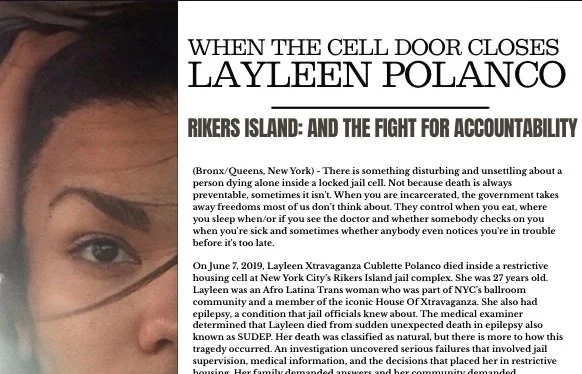
On June 7, 2019, Layleen Xtravaganza Cublette Polanco died inside a restrictive housing cell at New York City’s Rikers Island jail complex. She was 27 years old. Layleen was an Afro Latina Trans woman who was part of NYC’s ballroom community and a member of the iconic House Of Xtravaganza. She also had epilepsy, a condition that jail officials knew about. The medical examiner determined that Layleen died from sudden unexpected death in epilepsy also known as SUDEP. Her death was classified as natural, but there is more to how this tragedy occurred. An investigation uncovered serious failures that involved jail supervision, medical information, and the decisions that placed her in restrictive housing. Her family demanded answers and her community demanded accountability. The City of New York eventually agreed to a multimillion dollar settlement. The biggest question that remains: when someone dies in government custody, who is responsible for making sure the same thing doesn't happen again?
One thing I want us to remember throughout this series is that the people we’re talking about had lives before they were incarcerated. They were somebody's child, sibling, friend, chosen family. They had dreams and favorite movies and songs and hangouts and people who expected to see them again. After her death, Leyleen’s sister Melania Brown spoke of her grief in losing Layleen. It is a reminder that incarceration doesn't just affect the person locked up. When Layleen died, the loss extended far beyond Rikers Island.
Layleen couldn't post the $500 bail. Let’s talk about that number for a moment...hmmmm. For some people that amount means an unexpected bill or a strapped week, I’ve been there and I know I’m not the only one, but for someone whose freedom depends on a family member or friend being able to come up with that money…well, sometimes that is the deciding factor if you stay locked up or if you go home while awaiting your court date. There is an important distinction between being detained while awaiting trial versus being convicted or even being guilty of the charges you’re facing. The consequences of that detainment can be job loss, medical treatment can be interrupted or subpar and you may go long stretches with no contact with your family and friends. Layleen's case shows us how someone who is detained can be at risk in a way that has nothing to do with the charges that got them there. In Layleen’s case, she never made it home and while we can never be sure if she wouldn’t have had the same medical emergency out in the free world, we do know that she was put in restrictive housing away from the general population where there would have been more eyes on her. On the day she died, 47 minutes went by before anyone checked on her. A person with a known seizure disorder was inside a locked cell and the people in charge did not follow their own rules requiring regular observation. We can’t say when the seizures started but we do know that the jail failed to follow an important safety requirement, and if the purpose of these checks is to make sure those in your charge are safe and not in distress, then not doing the checks makes those safe guards useless.
Now we know that a written policy is only useful when people follow it, and in June of 2020, New York City Board of Corrections released a report on Layleen’s death. They found issues with her being housed in restrictive housing, communication of medical information, observation rounds and medication related procedures. The Board issued 25 recommendations to the DOC and their Health Services. That number should cause you to pause and even be angry. No criminal charges were filed after a six month investigation.
It’s a hard pill to swallow, when you’re told that the system failed your loved one, but at the same time no one is criminally responsible. Where is the accountability in that? Seventeen uniformed officers faced disciplinary action and the city settled with Layleen’s family for $5.9 million*. While that number has a lot of zeros, it did not establish a legal finding of liability and it doesn’t bring Layleen home to the people who loved her. It also doesn't answer whether the jail has corrected the problems that resulted in the tragedy in the first place. Everyone throws around the word ‘accountability’, but what does that actually look like? What does it actually mean when speaking about a system that is flawed and broken? The public funds these institutions, we should be able to follow the changes being made after the report found a need to make changes to policies.
Layleen’s identity matters to this story because being Black, Latina and Trans does not explain the medical cause of her death, but because those things shape how she experienced this world and the institution in which she was held. Trans people in custody face all kinds of challenges with where we are housed, safety, privacy and access to appropriate healthcare. For Black and Brown Trans people, we also have to navigate the racial discrimination and financial hardships. Incarceration does not erase someone’s humanity. Layleen was more than a person held at Rikers; she was part of a family that loved her.
Layleen’s is the first in my Blaque/Out’s newest limited series: “Cost Of Confinement”. Over the coming months this series will examine other deaths involving Black and Brown Queer people in correctional custody. These stories and circumstances are very different. What connects them is responsibility. When the government confines someone, they assume certain obligations for that person’s safety and care. And that doesn’t depend on whether they’re popular or can afford bail. It doesn’t disappear because they’re Trans, Black, gay or poor. Behind every cell door is a person whose life matters and when the door closes, our responsibility to care about what happens on the other side shouldn't either.
Next month, we look at the deaths of Lea Rayshon and Esias “Izzy” Johnson. What happens when the people responsible for your safety are the only people you can depend on for help?
*McMahon, Kate. (2020) The Death of Layleen Xtravaganza Cubilette-Polanco. New York Board of Corrections.
*Zaveri, Mihir. (2020). N.Y.C. to Pay $5.9 Million in Death of Transgender Woman at Rikers. New York Times.